
Inventory and condition report for a luxury villa: the method for avoiding disputes
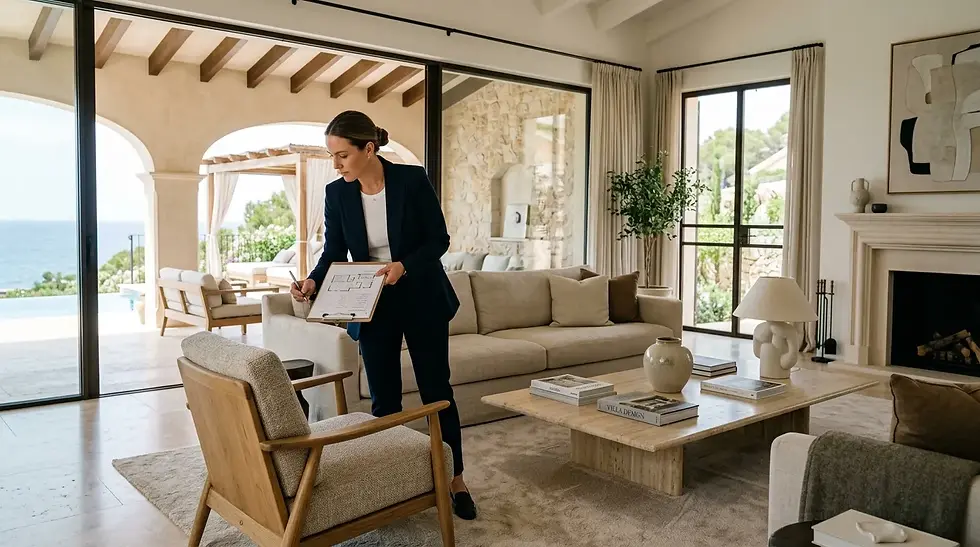
A good check-in report prevents disputes.
In a luxury villa, each room can contain furniture, linen, decorative items, technical equipment and sometimes annexes such as a pool, a garage or a wine cellar. The more precise the inventory, the easier it becomes to distinguish normal wear and tear from genuine damage, which is the aim of the legislation and professional guides on condition reports (état des lieux) and furnished rentals. (service-public.fr)
The right method is simple: a single clear document, dated photos, complete readings, then immediate signature by both parties. This is what makes the document useful if a security deposit is disputed later. (legifrance.gouv.fr)
Why an inventory is essential in a luxury villa
In an upscale property, a simple phrase such as “good condition” is not enough. You need to be able to describe the materials, brands, working condition and accessories of each piece of equipment. ANIL points out that in a furnished rental the inventory must detail the furniture and its condition, and the PAP guide even recommends stating the brand and, where useful, the reference value for high-end items. ANIL’s reminder and the PAP guide point in the same direction.
Designer furniture, seating and tables must be described one by one.
Technical equipment, such as home automation, air conditioning or household appliances, must be tested and recorded.
Textiles, bedding and tableware must be inventoried with enough precision to avoid any dispute.
Outdoor areas, the pool, the spa, shutters and annexes must be part of the same report.
For this work to run smoothly, it should be planned like a personalised check-in for a seasonal rental: the visit must allow enough time to read, check and have the document approved before the guests settle in. (pap.fr)
What the legal framework requires
The decree of 30 March 2016 provides for a written document, on paper or electronic, with the date, the location, the identity of the parties, the meter readings, details of the keys, a precise description of each room, any observations, images and the signature of the parties.
In a holiday rental, the landlord may request a security deposit, then return it in accordance with the contract. The Service-Public page on furnished holiday rentals (meublé de tourisme) clearly recommends a joint condition report on arrival and departure to avoid disputed deductions.
When there is no check-in report, ANIL points out that the tenant may be presumed to have received the property in good condition. This is precisely what makes the key handover stage so important. (anil.org)
The document can also be supplemented with reservations, observations and images, which is particularly useful in a villa where the materials and finishes deserve very close scrutiny.
The step-by-step method for a robust protocol
Here is the most reliable sequence: the same document, the same order of rooms, the same vocabulary, dated photos and immediate signature. The PAP guide also recommends using an identical template for check-in and check-out to make comparison easier.
Prepare a single condition report template and a separate inventory, both easy to read from the first page.
Organise the visit before personal belongings are brought in, as during a premium check-in / check-out, so that every defect can be seen without ambiguity.
Inspect the property room by room, then annex by annex, starting with the most heavily used areas.
Take dated photos of sensitive points and add them to the file with their exact location.
Read the meters, count the keys, remote controls and access devices, then have the document signed on the spot.
Immediately archive a complete copy, ideally as a PDF, with the photos and any reservations.
Another good habit is to complement the welcome with a villa house manual explaining how the appliances work, limiting misuse and preventing incorrect handling from later being mistaken for damage.
The financial logic is the same as in the dedicated article on condition reports, inventories and security deposits in seasonal rentals : what is proven is easier to defend when the deposit is returned.
Visual checklist for a luxury villa
This grid takes the requirements for precise description, signature, readings and images set out in the official framework, and adapts them to a luxury villa.
Inspection table by area
Area | What to record | Useful evidence | Risk if the item is overlooked |
|---|---|---|---|
Entrance and hallways | Condition of doors, locks, key boxes, lighting and secondary access points. | Photos, number of keys, remote controls, access badges. | Dispute over access or a missing item. |
Living and dining room | Sofas, tables, rugs, artworks, blinds, screens and home automation. | Dated photos, brands, dimensions, observations. | Dispute over a scratch, a stain or a connection. |
Kitchen | Household appliances, small equipment, tableware and consumables provided. | Numbered inventory, functional tests, interior photos. | Discussion about a missing or faulty appliance. |
Bedrooms and bedding | Mattresses, bed bases, linen, pillows, lamps and storage. | Photos, condition of textiles, brand if necessary. | Disputed deduction for worn bedding or linen. |
Bathrooms | Taps, seals, mirrors, towel warmers, shower screens and ventilation. | Close-up photos, readings and observations. | Debate over a leak or pre-existing breakage. |
Outdoor areas, pool and spa | Outdoor furniture, cover, filtration, lighting and accessories. | Photos, manuals, seasonal condition, check of controls. | Dispute over wear on equipment exposed to the weather. |
Annexes and technical rooms | Garage, cellar, plant room, storage and access security. | Plan, key inventory, photos of locked rooms. | Dispute over a space left out of the main report. |
Valuables | Decoration, light fittings, artworks, premium accessories and rare pieces. | Brand, model, dimensions, condition, detailed photo. | Disputed replacement or insufficient valuation. |
In a luxury villa, the key point is to leave nothing “out of frame”: annexes, access points, decorative objects, comfort equipment and outdoor areas must be documented with the same rigour as the main rooms.
The depreciation grid: the tool that prevents disputed deductions
The 2016 decree defines wear and tear (vétusté) as the wear or deterioration resulting from time or the normal use of materials and equipment. It also provides that the parties may agree on a depreciation grid when signing. Article 4 of the decree is the legal basis to bear in mind.
In practice, a luxury villa benefits from having a grid adapted to its categories of equipment, for example bedding, textiles, paintwork, indoor furniture, electronic devices and outdoor furniture. The aim is not to charge for every sign of ageing, but to clearly distinguish damage attributable to the tenant from simple normal use.
Consistent annual monitoring, such as that described in the maintenance schedule for a villa in the Gulf of Saint-Tropez, reduces the differences between the initial condition and the condition on departure, and therefore limits discussions about wear and tear.
Assign a reasonable lifespan to each category of equipment.
Specify what counts as normal wear and tear and what will be considered damage.
Apply the same logic to the interior and to outdoor equipment.
Keep the grid clear, simple and signed with the lease or rental agreement.
The mistakes that almost always lead to a dispute
Most conflicts do not stem from a spectacular problem, but from a lack of precision at the outset. Official and professional guides agree on the same points of vigilance: a detailed document, photos, signature, meters, keys and a strict comparison between check-in and check-out.
Using a different template for check-in and check-out.
Writing overly vague statements such as “good condition” without detail.
Forgetting annexes, secondary access points or outdoor equipment.
Failing to read the meters or count the keys and remote controls.
Signing too late, after the guests have already taken possession of the premises.
Not keeping a complete copy with the photos and reservations.
If a serious disagreement nevertheless arises, ANIL points out that a judicial officer (commissaire de justice) can step in and that the parties are summoned seven days in advance; the fees are shared. In the case of a holiday rental, Service-Public also specifies that the tenant may ask for supporting documents for any amounts withheld from the security deposit.
FAQ on the inventory and condition report for a luxury villa
How do you carry out an inventory and condition report for a luxury villa to avoid disputes?
The most reliable method is to use a single document template for check-in and check-out, go through the property room by room, then complete the report with dated photos, meter readings and the exact number of keys. The document must be signed immediately by both parties. For a luxury villa, include the annexes, outdoor equipment and valuables, as these are what most often give rise to discussions on departure.
What mandatory information should be included in the check-in report for an upscale villa?
The condition report must state the type of report, its date, the property’s address, the identity of the parties, any authorised representatives, the meter readings, details of the keys and a precise description of each room, its surfaces, its equipment and its fixtures. It can also be supplemented with observations, reservations and images. In a furnished rental, a detailed inventory of the furniture and equipment must also be attached.
How do you document the inventory of furniture and equipment in a luxury villa during the condition report?
The most effective approach is to create a separate inventory, organised by room, with a number for each item and a short but precise description: type, brand, condition, any particular feature and the associated photo. For high-end furniture, PAP even advises stating the brand and, where useful, the price or reference range, so as to have a basis for valuation in case of replacement. Also remember remote controls, accessories, linen, tableware and small items that are often forgotten.
How do you include a depreciation grid adapted to a luxury property to limit disputes when the deposit is returned?
The depreciation grid must be provided for when the contract is signed and used to distinguish normal wear and tear from genuine damage. The 2016 decree defines wear and tear as the effect of time or normal use, not as breakage attributable to the tenant. In a luxury villa, it makes sense to think in terms of equipment categories: textiles, bedding, paintwork, furniture, technical appliances and outdoor furniture. The simpler and clearer the grid, the easier it is to defend.
What steps are recommended if a dispute arises after the condition report in a luxury villa?
Start by comparing the check-in report, the check-out report, the photos, the messages exchanged and the supporting documents relating to repairs or deductions from the security deposit. Service-Public points out that the tenant may request supporting documents for amounts withheld in a holiday rental. If the disagreement persists, ANIL indicates that a judicial officer can be called upon to draw up an official report, which can serve as additional evidence.
What next?
If you are preparing a key handover in the Gulf of Saint-Tropez, put in place a single template, a dated photo album and a depreciation grid before the guests arrive. To find out more, you can browse the STYLE DE VIE home page or learn more about full villa management in the Gulf of Saint-Tropez to align inventory, welcome and property monitoring. To go further, visit STYLE DE VIE.


