
Personalised check-in for seasonal rentals: creating a memorable first impression
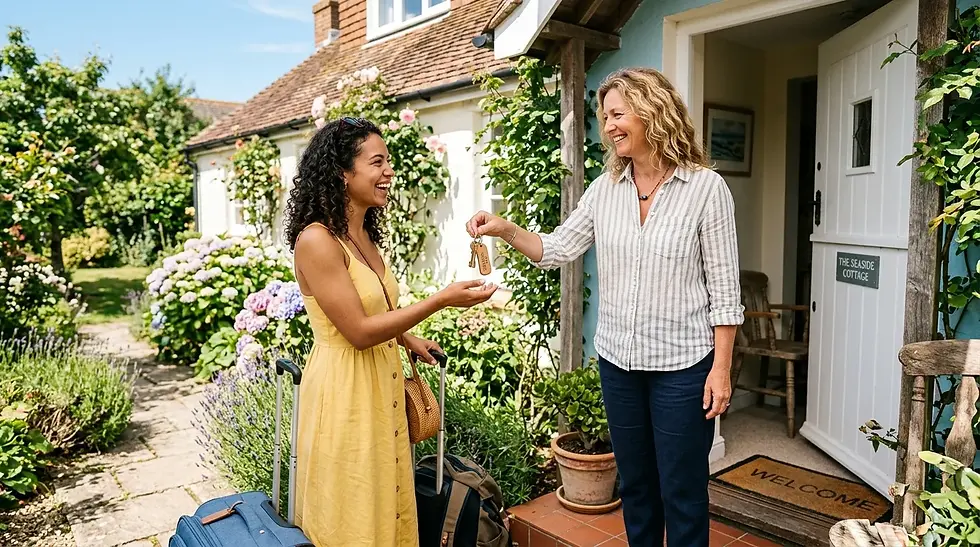
Check-in is decided in a matter of minutes. A well-thought-out welcome can change the way the whole stay is perceived, because first impressions, high points and last impressions strongly influence overall satisfaction in hospitality.
In seasonal rentals, reviews often come back to communication with the host, check-in/out and cleanliness. Across the industry, the AHLA also pointed out in 2025 that cleanliness remains a major criterion for choosing and rating accommodation. (mdpi.com)
Why personalised check-in is a game changer
A field study published in 2024 covering more than 5,000 stays concludes that the first impression is the most decisive moment for the overall rating, ahead of other peaks in the experience. For a holiday villa or apartment, this means that the entrance, the clarity of the instructions and the quality of the first exchange are not mere details.
Research on check-in also shows that this emotional transition influences trust in the accommodation and future intentions. In other words, a smooth arrival creates a positive mindset even before guests open their suitcases. (sciencedirect.com)
In short-term rentals, the analysis of reviews highlights three recurring themes: communication with the host, check-in/out and cleanliness. This is exactly why the welcome must be designed as a complete journey, not just a key handover.
If you want to frame this sequence from start to finish, the article on check-in and check-out in seasonal rentals helps you build a consistent experience from arrival to departure.
The levers of a welcome that leaves a lasting impression
The right balance rests on three words: clarity, personalisation and continuity. Research on personalised host responses and on the guest experience in accommodation shows that a tailored message and attention at every stage encourage more bookings and greater loyalty. (sciencedirect.com)
Anticipate before arrival: send a short, useful, personally addressed message with the information that is genuinely necessary to reduce the guest's stress.
Make access obvious: add simple visual cues, clear entry directions and a route that is easy to follow from the car or the pavement.
Create an easy-to-read space: every useful area should be easy to identify, so that guests immediately know where to put their belongings, how to find their way around and where to find the essentials.
Take care over the welcome gesture: a small, tastefully chosen touch is better than an accumulation of unrelated items.
Provide a human point of contact: even in an automated process, guests must feel that they can get a quick answer if something unexpected happens.
Prepare for departure from arrival: a simple departure instruction avoids misunderstandings and extends the good impression right up to departure, as the article on check-in and check-out in seasonal rentals points out.
These levers reflect what research most often highlights: a strong start to the stay, easy-to-read instructions, tailored exchanges and a consistent level of cleanliness.
Premium check-in checklist
Stage | Concrete action | Expected effect | Point to watch |
|---|---|---|---|
48 hours before arrival | Send a personalised pre-arrival message and a reminder of the essential information. | Guests arrive more relaxed and better prepared. | Avoid messages that are too long or contradictory. |
On the day | Provide a visual access route with simple cues that can be read quickly. | Entry becomes intuitive and less stressful. | Avoid vague or overly technical wording. |
On opening the property | Create a clean, tidy and welcoming first glance. | The first impression is immediately positive. | Leave nothing to chance when it comes to visible cleanliness. |
First minutes on site | Highlight a simple, discreet and consistent welcome gesture. | Guests feel expected, not merely admitted. | Avoid overloaded or unhelpful touches. |
Before departure | Remind guests of the check-out instructions in a very short format. | Departure remains smooth and frictionless. | Avoid too many departure requests. |
This grid summarises the recurring lessons from research: a decisive first impression, emotional check-in, host-guest communication and the importance of an impeccable environment.
The digital welcome guide as an extension of check-in
An effective digital welcome guide should not look like an endless instruction manual. Research on map-based wayfinding points out that a complex environment becomes simpler when the cues are clear, and studies on digital tourism services link perceived quality, satisfaction and loyalty.
In a seasonal rental, this translates into short sections, pictograms, quick access via a QR code and content that gets straight to the point. The villa house manual can then become the heart of your welcome system, especially if several people work on the same property.
The most useful sections are generally the same:
The route to the property, presented in a few simple steps.
How the essential equipment works, without unnecessary jargon.
The main house rules, worded clearly and respectfully.
Useful information about the stay, to answer the most frequently asked questions.
Local recommendations, selected to be genuinely practical.
The touches that make guests feel expected
Material touches count when they are discreet and consistent with the standard of the property. A 2025 Cornell study shows that giving guests a degree of control or ownership over the space increases loyalty, review length and perceived satisfaction, and other research on personalised host responses points in the same direction. (business.cornell.edu)
A personalised welcome note, a cool drink, a basket of local produce or a carefully presented property create an immediate sense of attentiveness. To detail the essentials without straying into the superfluous, the villa welcome kit remains a good starting point.
It all works even better when the space is impeccable, because cleanliness remains a major criterion in guests' decisions in 2025. (ahla.com)
A concrete example: a couple arrives late after a delayed flight. The day before, they receive a short, personalised message, a visual access map, the digital guide and a welcome note ready in the living room. At the entrance, everything is easy to understand, the space is clean and the first impression is positive even before the first night.
When to entrust the welcome to a concierge service
When arrivals follow one after another, when a villa is far away or when you are looking for consistent quality all year round, delegating the welcome helps secure the experience. The logic is simple: less friction, more reliability and continuity between arrival, stay and departure, exactly what hospitality studies associate with greater overall satisfaction.
It is also what prevents an access question from turning into an incident. A well-orchestrated check-in reduces repetition, misunderstandings and urgent exchanges, while leaving guests with the feeling that they have been looked after seriously.
Mistakes to avoid at all costs
Giving too much information at once, at the risk of drowning out the essentials.
Offering access that is hard to follow, when arrival should be intuitive.
Sending the same message to all guests, without taking the context of the stay into account.
Neglecting check-out, when a clean and clear departure extends satisfaction.
Forgetting a plan B in the event of a technical problem or a late arrival.
These mistakes may seem minor, but they damage the perception of the service at the very moment it is being formed. As research on check-in shows, the transition itself has a lasting emotional effect; if it is confusing, trust erodes quickly.
FAQ
How can you personalise check-in for a seasonal rental to create a memorable first impression?
Start with a short, useful pre-arrival message addressed to the guest by name, then adapt the content to the purpose of the stay: family holiday, weekend with friends or business trip. Add visual access cues, a clear guide and a welcome gesture consistent with the standard of the property. The aim is not to impress through quantity, but to make guests feel that they were expected and understood. Research on first impressions, check-in and personalisation all points in this direction.
What information should you include in a digital welcome guide to impress your guests from the moment they arrive?
The most useful approach is to stay practical: access to the property, parking instructions, how the Wi-Fi works, essential equipment, house rules, a summary of check-out and carefully selected local recommendations. A good digital guide must also be easy to browse, with short headings, legible visuals and quick access via a QR code. Studies on wayfinding and digital tourism services show that clarity and perceived quality strengthen satisfaction and loyalty.
How can you organise a check-in without anyone present and automate the welcome in a short-term rental?
Automation works well when it simplifies information without removing the human connection. Prepare a sequence of scheduled messages, an illustrated access route, an immediately accessible digital guide and a back-up solution in case of the unexpected. Research on check-in shows that this phase influences trust, while the short-term rental experience relies heavily on host-guest communication. Automation should therefore serve clarity, not replace availability.
Which personalised welcome elements (QR codes, local guides, pre-arrival messages) maximise positive reviews?
The most effective elements are often the simplest: a warm pre-arrival message, a QR code linking to the guide, a genuinely useful mini local guide and a small touch suited to the stay. Research shows that personalisation strengthens satisfaction and loyalty, and that a sense of ownership of the space encourages longer and more positive reviews. Everything must remain consistent with the standard of the property and the promise made to the guest.
How can you align personalised check-in with platform rules and guest expectations to improve the overall rating?
The right method is to maintain perfect consistency between the listing, the instructions sent and the actual experience on site. The exact rules vary from platform to platform, but above all guests expect reliable information that is easy to find and free of contradictions. In practice, a short procedure, clear messages, easy access to the guide and a check-out with no surprises are best. Studies on check-in and service quality show that this continuity improves the overall perception of the stay.
What next?
If you would like to turn arrival into a signature of hospitality, first structure your guest journey, then bring it to life day after day. You can discover Style de Vie concierge services, return to the world of STYLE DE VIE or contact STYLE DE VIE to discuss your seasonal rental project. To find out more, visit STYLE DE VIE.


