
Property Security in Holiday Rentals on the Côte d’Azur: Alarms, Safes and Good Practices
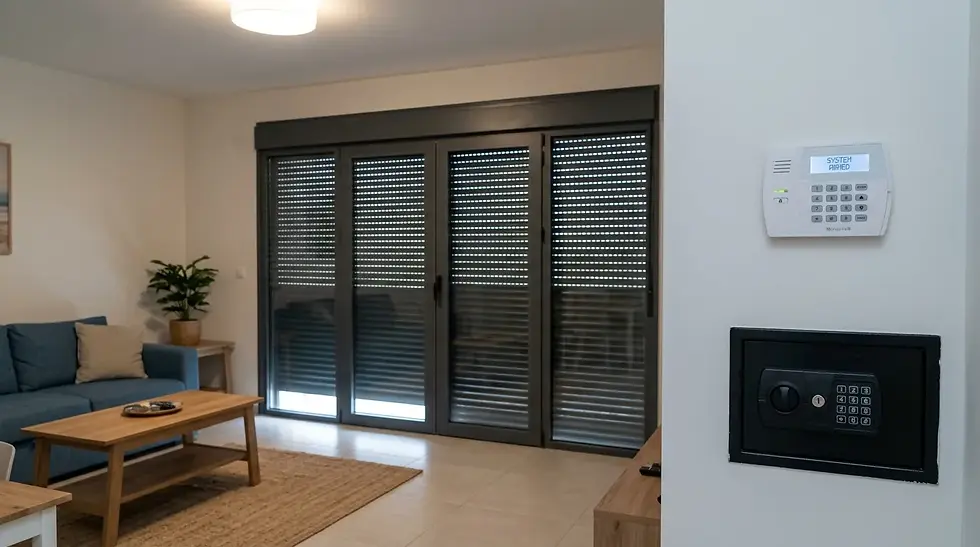
Property security starts on arrival.
In a holiday rental, security must be designed for repeated absences, frequent key handovers and valuables that are sometimes on display. The French Ministry of the Interior recommends protecting access points, not leaving keys outside, putting jewellery and valuables in a safe place and photographing these items before leaving. Service-Public also points out that no insurance is legally mandatory for a furnished holiday rental (meublé de tourisme), even though appropriate cover remains strongly advised. (gendarmerie.interieur.gouv.fr)
On the Côte d’Azur, the right reflex is not to pile up gadgets, but to build simple, visible and consistent protection: controlled access, a credible alarm, a discreet safe and clear instructions for each stay.
Why property security is different in a holiday rental
In a villa or apartment rented by the week, the logic is not that of a main residence. The property alternates between occupied and empty periods, with technical visits, late arrivals and sometimes hurried departures. The aim is therefore to make any break-in slower, noisier and harder to plan.
This approach is particularly useful on the Côte d’Azur, where prestige properties, terraces, garden access points and short stays create situations very different from a home lived in all year round. In practice, you need to think in terms of a chain: access, alarm, storage, keys, guest information and control of service visits.
Alarm: choosing a useful system, not just a reassuring one
For a villa occupied intermittently, the ideal is to aim for a certified wireless or hybrid system, with detectors on access points and reliable notification. Standard NF EN 50131 covers intrusion alarm systems using wired or wireless connections, the NF EN 50131-5-3 series governs radio equipment installed inside protected premises, and CNPP specifies that NF&A2P certification is based on laboratory testing and a manufacturing audit. The table below helps compare the families of equipment. (boutique.afnor.org)
Guidelines for choosing your equipment
Solution | Main benefit | For what use? | Point to watch |
|---|---|---|---|
Certified wireless alarm | Quick installation, easy adjustment between stays, detectors on the most exposed access points. | Villas and apartments occupied intermittently. | Check the quality of the certification, battery maintenance and radio range. |
Wired alarm | A more structured solution when the property is managed over the long term. | Renovated properties or those already wired for security. | It requires more work and adapts less well to frequent changes. |
A2P-certified safe | Enhanced protection for valuables, documents and small items. | High-end properties or homes with sensitive items. | The safe must remain discreet and properly anchored. |
Smart locks | Simpler management of codes, badges and temporary access. | Frequent key handovers and staggered arrivals. | Updates and passwords must be flawless. |
Safe: useful, provided it is chosen and installed correctly
A safe makes sense as soon as there are items that are easy to carry off: jewellery, watches, passports, spare keys, contracts or cash. CNPP specifies that A2P certification classifies safes according to their resistance to break-ins, within a framework linked in particular to standards EN 1143-1 and EN 14450. To be truly useful, the safe must remain discreet and be firmly anchored. (cnpp.com)
Good practices that make a difference day to day
The simplest measures are often the most effective. For a holiday rental, especially when stays follow one another quickly, you need to think like an absent owner and like a guest passing through: nothing accessible, nothing visible, nothing predictable. Official guidelines recommend in particular closing windows, not hiding keys outside, not announcing your holidays on social media, having your mail forwarded and asking a trusted person to drop by regularly.
Reflexes to apply before each stay
Store ladders, screwdrivers, hammers and other tools in a locked room.
Test the alarm before each arrival and after each departure to check the batteries, range and alerts.
Keep valuables in a discreet safe or off the premises if the use of the property allows it.
Inform the guest of the security rules at check-in, to avoid windows, gates or secondary doors being left open.
Photograph valuables and keep a clear record of what remains on site between stays.
To make this step smooth, a personalised check-in helps present the instructions without making arrival cumbersome, while the inventory and check-in/check-out report for a prestige villa make it easier to keep track of sensitive items and accessories left on site.
Managing keys and access without multiplying risks
When arrivals follow one another, managing duplicates, badges and codes deserves the same rigour as smart locks and key management. The gendarmerie points out that burglars often work by scouting and that you should remain alert to door-to-door callers, unexpected visitors and any suspicious behaviour.
Preparing for the season on the Côte d’Azur
On the Côte d’Azur, the protection of a seasonally rented property must work all year round, not just in summer. A simple routine consists of checking access points, testing the alarm, securing valuables, archiving photos and preparing key handovers. If you want to structure the entire follow-up, the complete guide to villa management in the Gulf of Saint-Tropez helps coordinate security, maintenance and guest welcome between stays.
FAQ on property security in holiday rentals
How can I protect my holiday rental against burglary?
You need to combine several layers of protection: a door with a reliable lock, suitable approved equipment, windows closed during absences, keys never left outside, and valuables kept out of reach. The gendarmerie also recommends not announcing your absences on social media, having someone come by for the mail and the shutters, and requesting an OTV (Opération Tranquillité Vacances) patrol when the property is empty. In a villa, effectiveness comes above all from repeating these measures, not from a single piece of equipment.
Which portable wireless alarms should I choose for a holiday rental?
For a property occupied intermittently, a certified wireless alarm is often the most flexible solution. Standard NF EN 50131 covers wired and wireless systems, and standard NF EN 50131-5-3 governs equipment using radio links inside protected premises. The right choice combines a control panel, detectors on access points, an audible siren and, if necessary, alert notifications. Before buying, check the certification, then secure the app with a strong password and regular updates.
Should I install a safe in a holiday rental, and how do I choose one?
Yes, as soon as there are small but high-value items, such as jewellery, watches, passports or spare keys. The ideal is an A2P-certified safe with appropriate break-in resistance, properly anchored and discreetly placed. The Ministry of the Interior recommends not making it visible and fixing it to the floor and wall. In practice, the right safe is the one that matches the value actually stored, the space available and the level of security expected by the owner or their insurer.
What are the good practices for protecting rented properties on the Côte d’Azur?
The best reflexes are very practical: close everything that can be closed, do not leave tools within easy reach, photograph valuables, avoid visible information on keys, and clearly inform occupants of the instructions. On the Côte d’Azur, where turnovers are frequent, you also need to organise key handovers, maintenance visits and access checks so as not to leave a window open between stays. This discipline reduces opportunities for scouting as much as it reduces oversights by service providers.
What next?
If you want to strengthen the protection of your property without weighing down the guest experience, start with a simple foundation: secure access, a certified alarm, a discreet safe and clear procedures between each stay. To go further, return to STYLE DE VIE and build a more serene organisation around your villa. To go further, visit STYLE DE VIE.


